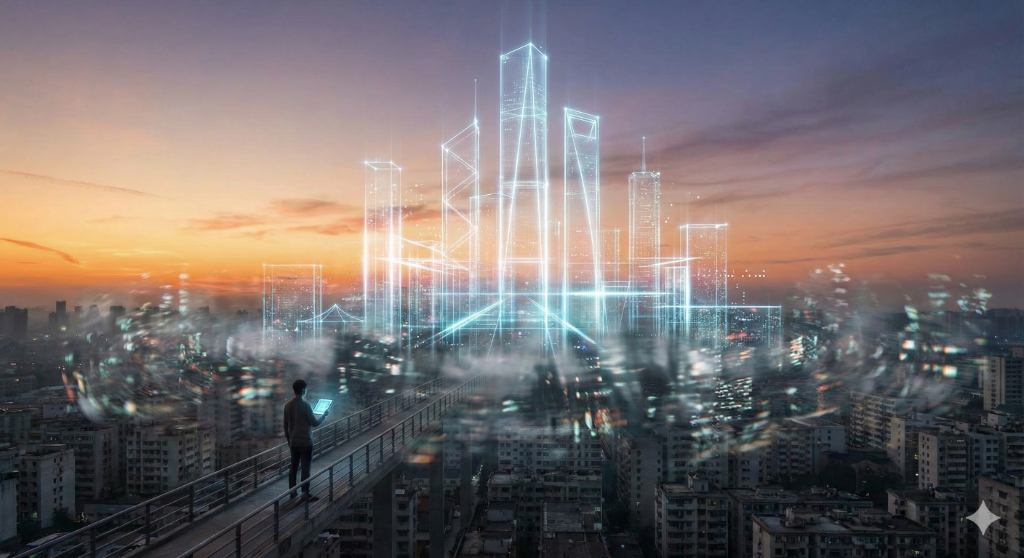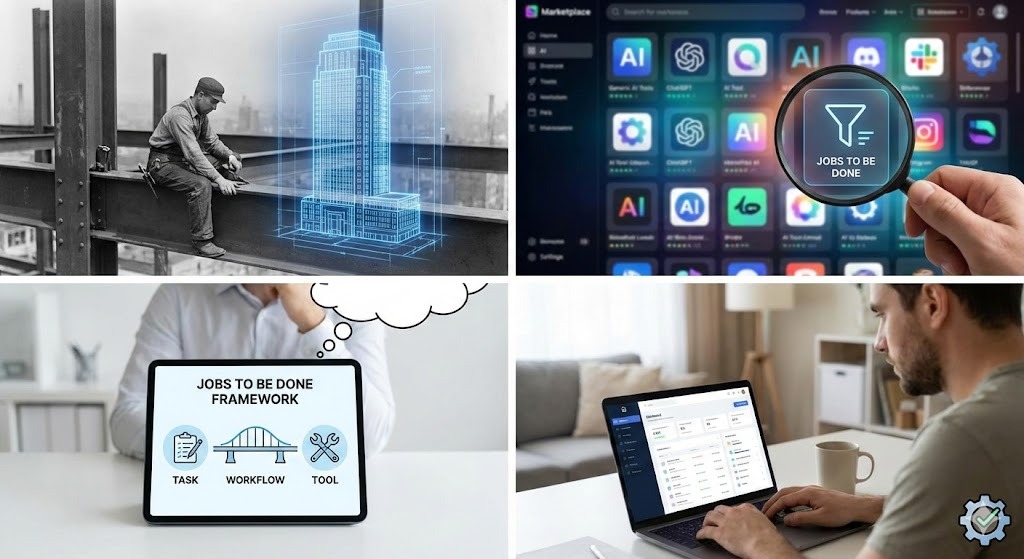
AI is starting to feel like a miracle material. Not because it is magical, but because it changes what is possible at the margins—faster than our habits can keep up.
In past eras, the winners were often the ones who learned to work with the new material first. Steel made skyscrapers practical. Electricity made factories continuous. Semiconductors made information cheap.
AI is making capability cheap. And that is the beginning of a new kind of confusion.
The paradox of abundance
The last time you picked a keyboard, you could compare a handful of credible options. Even if you took it seriously, you were still browsing a finite shelf.
AI doesn’t feel like a shelf. It feels like an ocean that keeps rising while you are trying to take a sip.
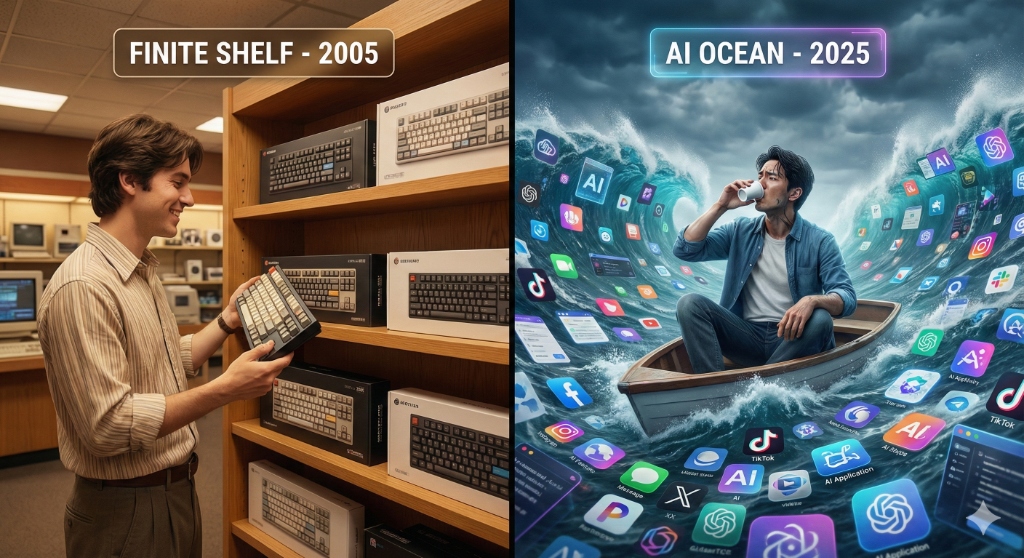
Abundance can feel like drowning without a vessel.
Every week brings new names, new demos, new promises. Some are genuinely useful. Some are just a wrapper. Many are impossible to evaluate without trying them in your own workflow.
So the paradox appears: AI is meant to save time, yet choosing the right AI utility can become its own full-time job.
Driving into the future via the rearview mirror
When new technology arrives, we first use it to imitate old forms. Early films looked like recorded stage plays. Early cars looked like motorized carriages.
Most AI discovery still looks like search from 2005. A query box, a list of links, and a lot of human effort to figure out what is real.
The problem is not that search is bad. The problem is that the world changed underneath it.
AI utilities differ in ways that are not captured well by keywords. Two utilities can claim the same feature and behave completely differently in practice.
And when everything calls itself “AI-powered,” the label stops meaning anything. We return to the oldest decision method: vibes.
Individuals: from curiosity to paralysis
Picture a PM who is trying to choose an AI writing assistant for a team. They start responsibly. They open a few tabs. They read a few reviews.
Then the decision begins to spread. One person cares about pricing. Another cares about privacy. Someone wants proof of adoption. Someone else insists on integrations.
By day two, the research looks like a detective board. By day five, people stop reading and start arguing.
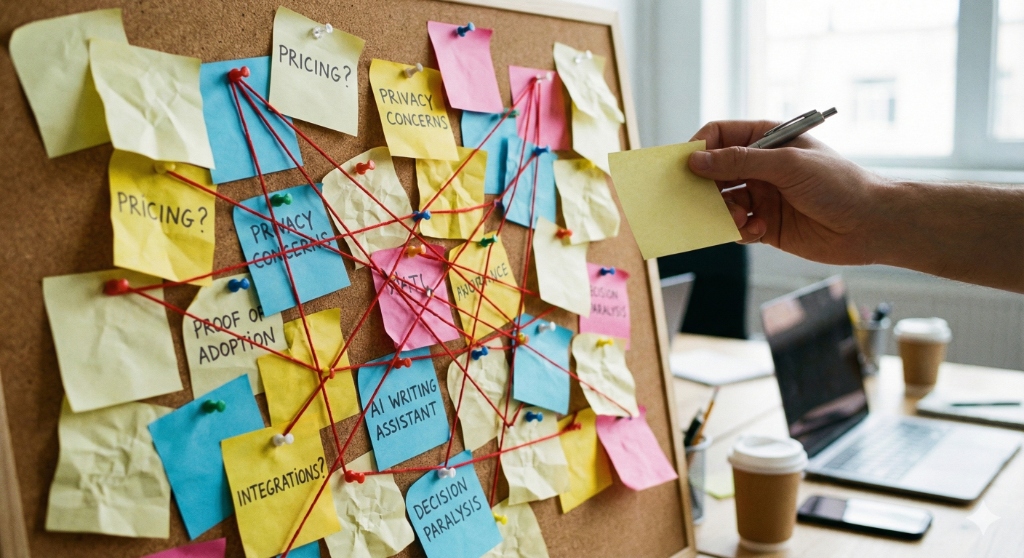
When the research spreads too thin, the decision stalls.
Two bottlenecks show up again and again.
First, discovery overload. When there are too many options, the brain does not become more rational. It becomes more avoidant. You delay, you default, or you pick the loudest name.
Second, comparison opacity. The information exists—on vendor sites, in communities, inside long threads—but it is fragmented and biased. Vendors naturally emphasize their best angle. Review sites naturally emphasize whoever pays attention to them.
The result is not ignorance. The result is uncertainty that is expensive to resolve.
Organizations: steel and steam
Organizations love reusable processes. They also love repeatable decisions.
But the AI landscape makes both hard.
The “research” phase stretches because every stakeholder is asking a different question. Engineering wants feasibility. Finance wants pricing. Leadership wants evidence that the choice is not a fad.
Without a shared reference, the conversation turns into a meeting about meetings. The decision becomes less about selecting a good option and more about aligning people.
This is where steel is a useful metaphor. Before steel, you could build tall, but the structure fought you. After steel, height stopped being the primary constraint.
A structured intelligence layer is steel for decisions. It holds weight that humans otherwise carry in their heads and inboxes.
We are still in the “swap out the waterwheel” phase of AI evaluation. Many teams are applying old procurement habits to a world that changes weekly.
They do not need more opinions. They need a way to see tradeoffs clearly, in one place, with consistent dimensions.
Economies: from catalogs to terminals
A century ago, Sears catalogs changed how people discovered goods. They turned a scattered marketplace into a browsable system.
Later, terminals changed how finance made decisions. Not because they predicted the future, but because they made the present legible—fast enough to act.
The AI ecosystem is now large enough that legibility matters more than novelty. It is not enough to “know what exists.” You need to know what is credible, what is growing, what fits your constraints, and what you are trading away.
As this market matures, the advantage will shift. From “who has access to the most options” to “who can choose confidently with the least wasted motion.”
That shift sounds small. It is not.
What a better decision experience looks like
A better experience does not feel like a spreadsheet war. It feels like clarity arriving early.
You start with intent, not keywords. You narrow fast without losing important alternatives.
You compare with consistent structure. You see adoption signals, pricing patterns, and category context without having to assemble it by hand.
And when you ask for a recommendation, you get more than a list. You get reasoning, fit, and tradeoffs—so you can disagree intelligently.
This is not about chasing perfect certainty. It is about cutting the cost of learning.
A quiet mention, late in the story
Enter Kinetiq. The goal is not to tell people what to choose. The goal is to reduce the time it takes to choose well.
Kinetiq keeps a large, structured catalog of AI utilities, supports side-by-side comparisons, and includes an “Ask AI Matchmaker” flow that returns shortlists with clear reasoning and alternatives. When it works, it feels less like browsing and more like thinking with a clean desk.
There is still a long road ahead. But the direction feels right: decisions should become simpler as the world becomes more complex, not the other way around.
The skyline we are walking toward
Every era gets its own kind of noise. Every era also gets new ways to cut through it.
AI is abundance. The next advantage is clarity.
The people who build clarity into their decisions will move faster, with fewer regrets. And the ones who ignore the cost of confusion will keep paying it—quietly, every week.
The next skyline is there, waiting for us to build it.